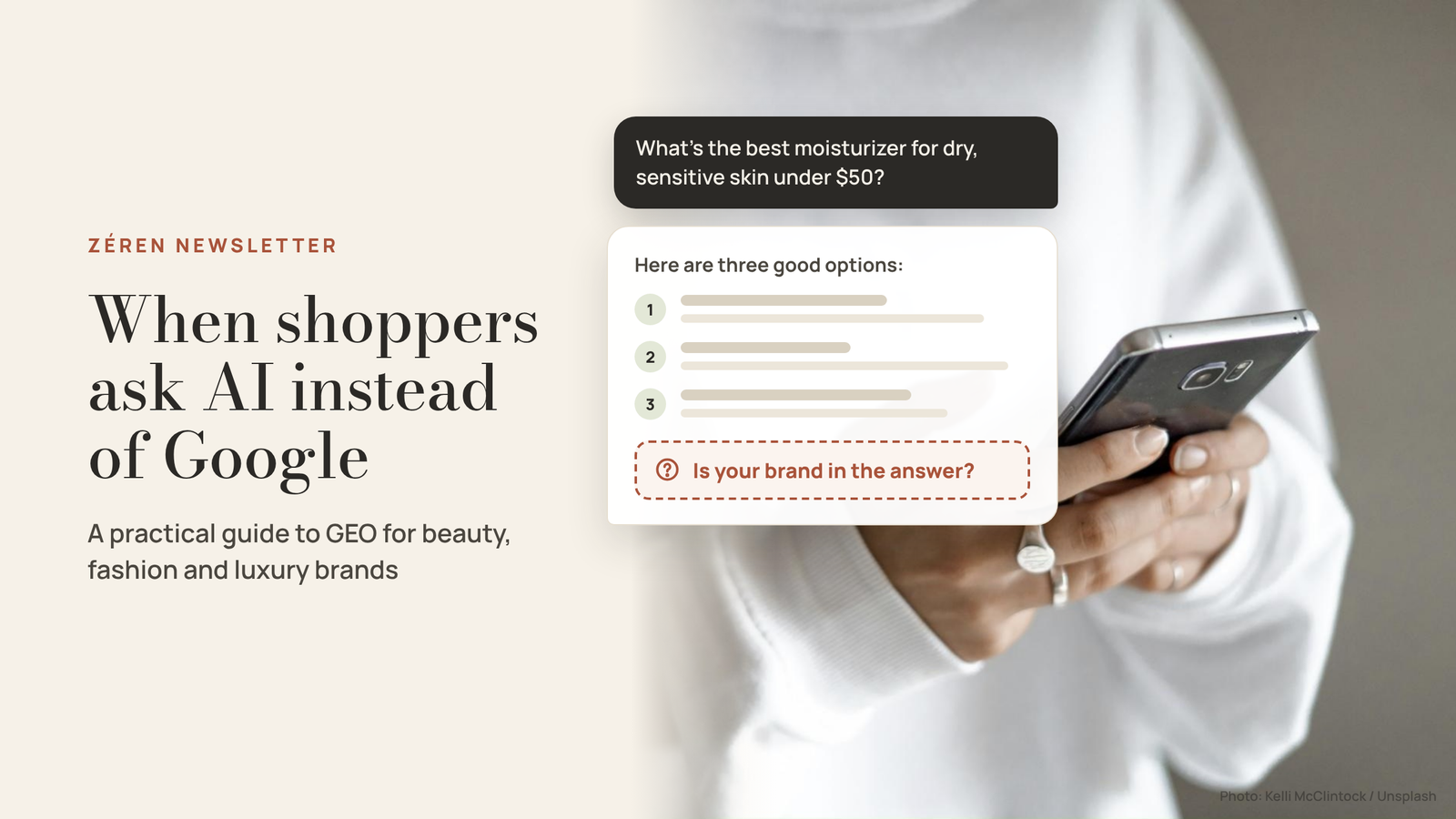
Ask ChatGPT for the best moisturizer for dry, sensitive skin under $50 and you get three or four products, each with a one-line reason. There is no page of links to scroll through. If your product isn’t in that short answer, the shopper never hears of it.
Getting into that answer is what people now call generative engine optimization, or GEO. Shoppers are already asking. Adobe tracked AI traffic to US retail sites up 393% year over year in Q1 2026, and by March those visitors converted 42% better than other traffic. In Adobe’s survey of more than 5,000 US consumers, 39% said they had used AI to shop online.1
In this issue we look at how AI tools choose what to recommend, how six platforms differ, and what beauty, fashion and luxury brands can change this quarter.
SEO, AEO and GEO
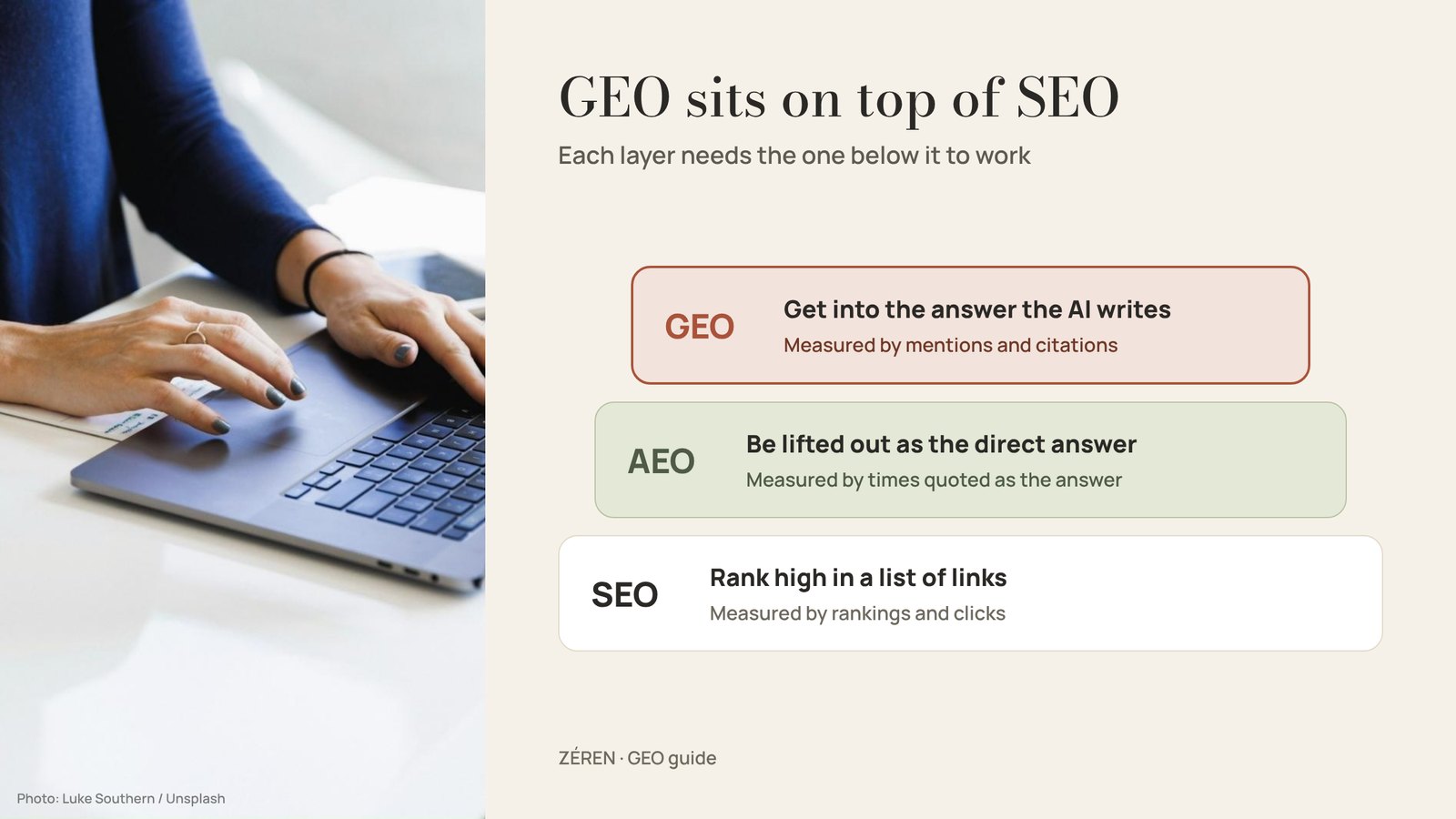
GEO doesn’t replace SEO. It sits on top of it.
- SEO gets your page ranked in a list of links. You measure it in rankings and clicks.
- AEO, answer engine optimization, gets your page lifted out as the direct answer, like a featured snippet. You measure how often you’re the quoted answer.
- GEO gets your brand into an answer the AI writes from several sources. You measure how often you’re mentioned and cited.
Google says a page needs no special work to appear in AI Overviews or AI Mode beyond being indexed and eligible to show a snippet.2 A site with weak SEO rarely does well in AI answers. What changes is the goal: you want to be the source the AI decides to use, and a ranking is only the way in.
How an AI tool picks what to cite
Most AI search tools work in three steps: they search, they read, then they write.
- Search. The tool turns one question into several searches. Google calls this query fan-out: AI Mode and AI Overviews may run related searches across subtopics to build a single answer.2
- Read. It pulls the strongest few pages into the model’s working context.
- Write. The model writes a new answer from those pages and links some of them as sources.
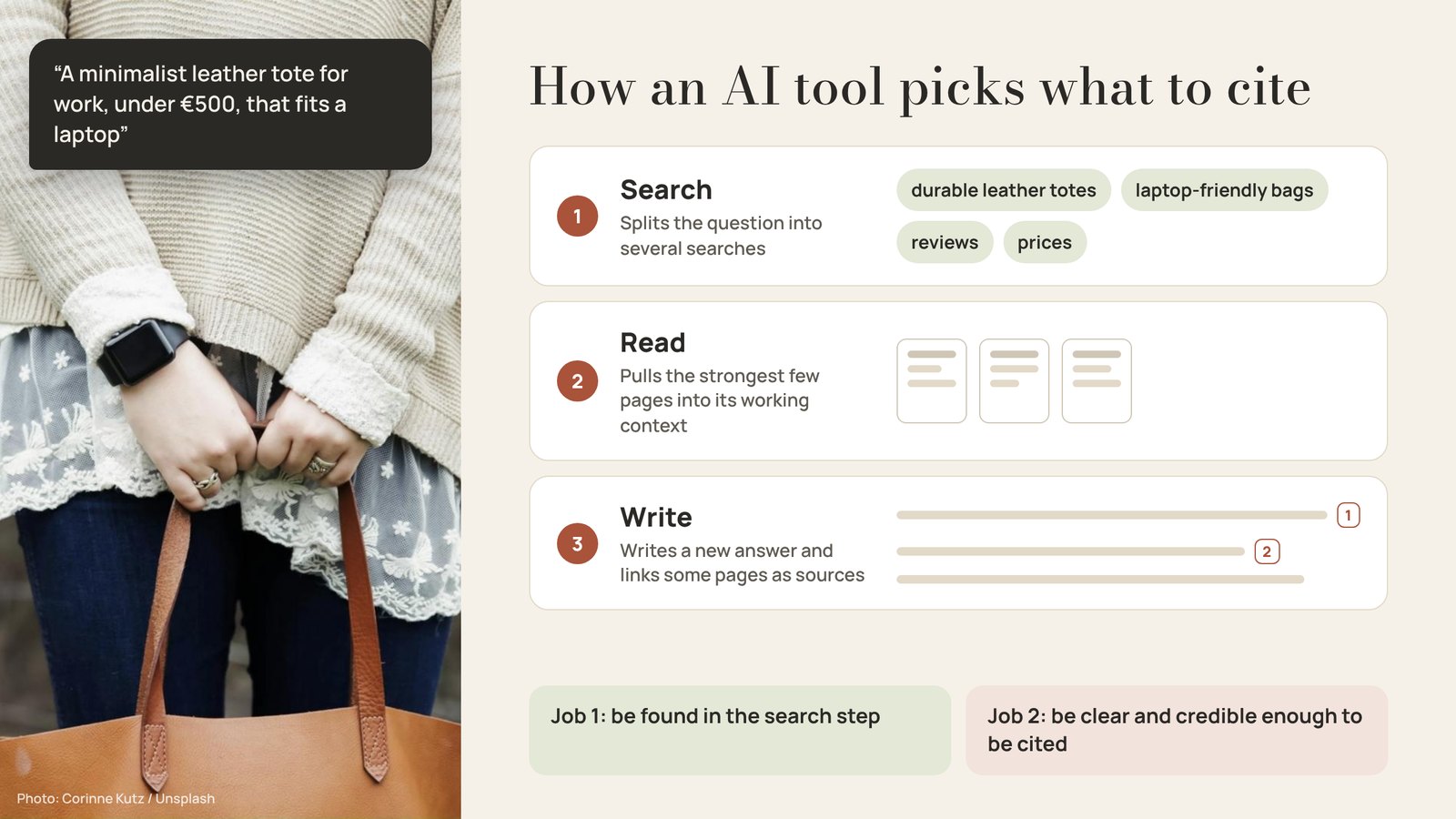
Picture a shopper asking for a minimalist leather tote for work, under €500, that fits a laptop. The tool may search separately for durable leather totes, laptop-friendly bags, reviews and prices. A product page that answers each of those questions has more chances to be picked.
That leaves a brand two jobs. Be found in the search step, then be clear and credible enough to be used and credited when the answer is written.
Platform by platform
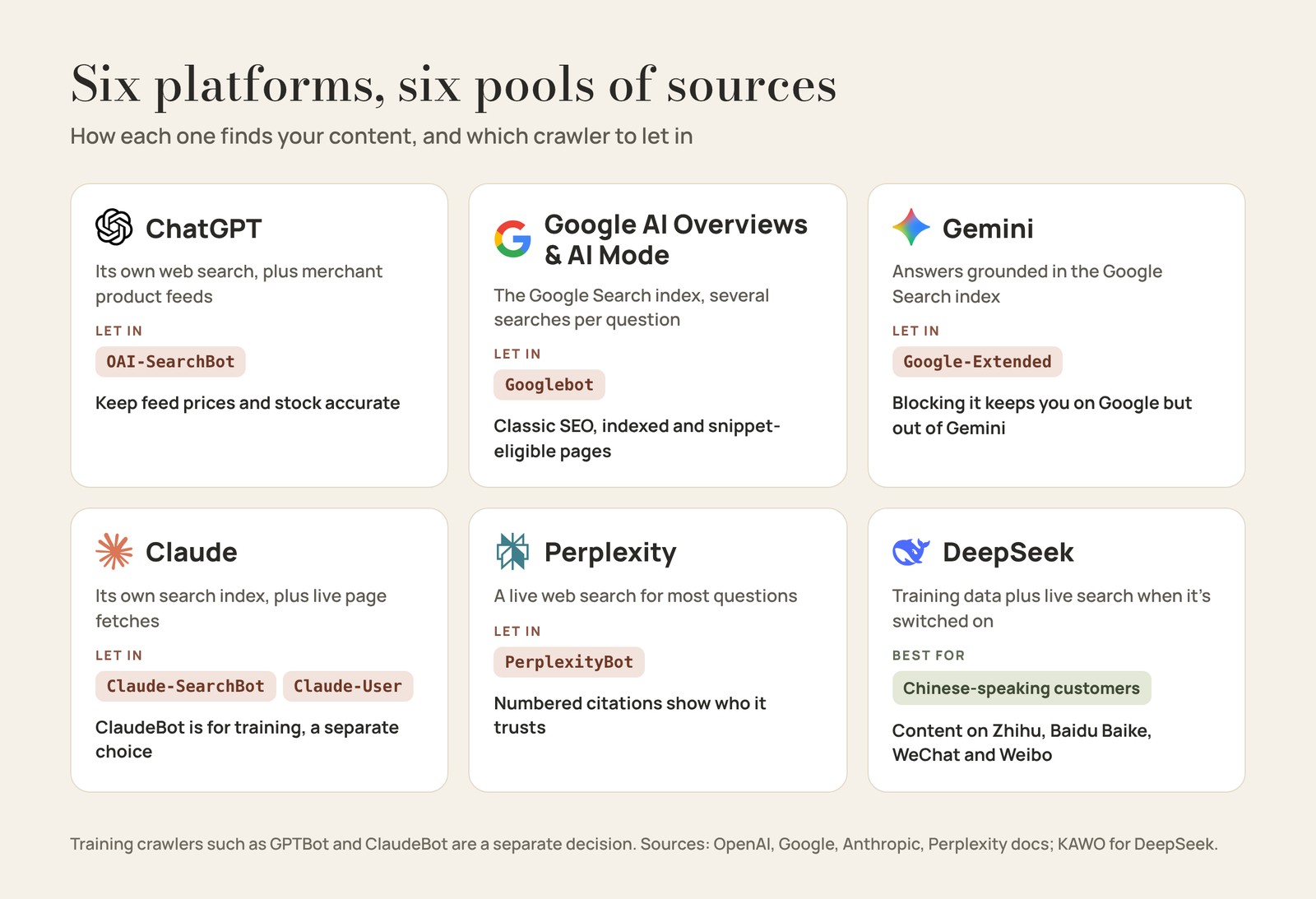
The basics hold everywhere, but each platform searches its own pool of sources and has its own crawlers.
ChatGPT
Any public site can appear in ChatGPT search, as long as it doesn’t block OpenAI’s search crawler, OAI-SearchBot.3 GPTBot is a separate crawler that collects training data, so you can block GPTBot and still show up in search.
For shopping, ChatGPT reads structured product data such as price and description, plus summaries of public reviews. Merchants can also apply to send a product feed directly, and Shopify stores are already connected through Shopify Catalog.4 The tracking firm Profound saw the share of ChatGPT shopping picks coming from merchant feeds jump from about 8% to 62% in July 2026, a change OpenAI hasn’t confirmed.5 Links from ChatGPT carry utm_source=chatgpt.com, so the visits show up in your analytics.3
Google AI Overviews and AI Mode
Google says there are no extra requirements. The page has to be indexed and eligible for a snippet, and any structured data should match what’s visible on the page.2 Classic SEO strength matters most here. Traffic from these features is counted with your normal Web search numbers in Search Console.2
Gemini
The Gemini app grounds answers in content from the Google Search index. A robots.txt token called Google-Extended controls whether your content is used to train Gemini models and to ground answers in the Gemini app. Google says it has no effect on inclusion or ranking in Google Search.6 A brand that blocks Google-Extended can still rank on Google while staying out of Gemini’s answers.
Claude
Claude can search the web, and Anthropic runs three crawlers.7 ClaudeBot collects training data. Claude-SearchBot indexes pages for search, so blocking it keeps you out of Claude’s search results. Claude-User fetches a page when someone asks Claude about it, and blocking it stops Claude reading your page for that person.
Perplexity
Perplexity runs a live web search for most questions and puts numbered citations next to its claims.8 PerplexityBot is the crawler that surfaces sites in its results, and Perplexity recommends allowing it.9 Because sources are shown so plainly, Perplexity is the easiest place to see which sites an AI trusts in your category.
DeepSeek
DeepSeek matters most if you sell to Chinese-speaking customers. With search switched on, it combines what it learned in training with live sources. For brand questions it tends to draw on Chinese platforms such as Zhihu, Baidu Baike, WeChat and Weibo.10 For a European or American brand entering China, a translated website is not enough. The brand needs content on those platforms.
What makes content easier to cite
The best evidence so far is a 2024 study by researchers at Princeton University and IIT Delhi, the paper that introduced the term GEO. They rewrote web pages in different ways and measured how much of each page showed up in AI-written answers.11
Adding quotations from credible people raised a page’s visibility by about 41%. Adding statistics raised it by about 31%, and citing sources by about 28%. Keyword stuffing, an old SEO habit, lowered it by about 8%.
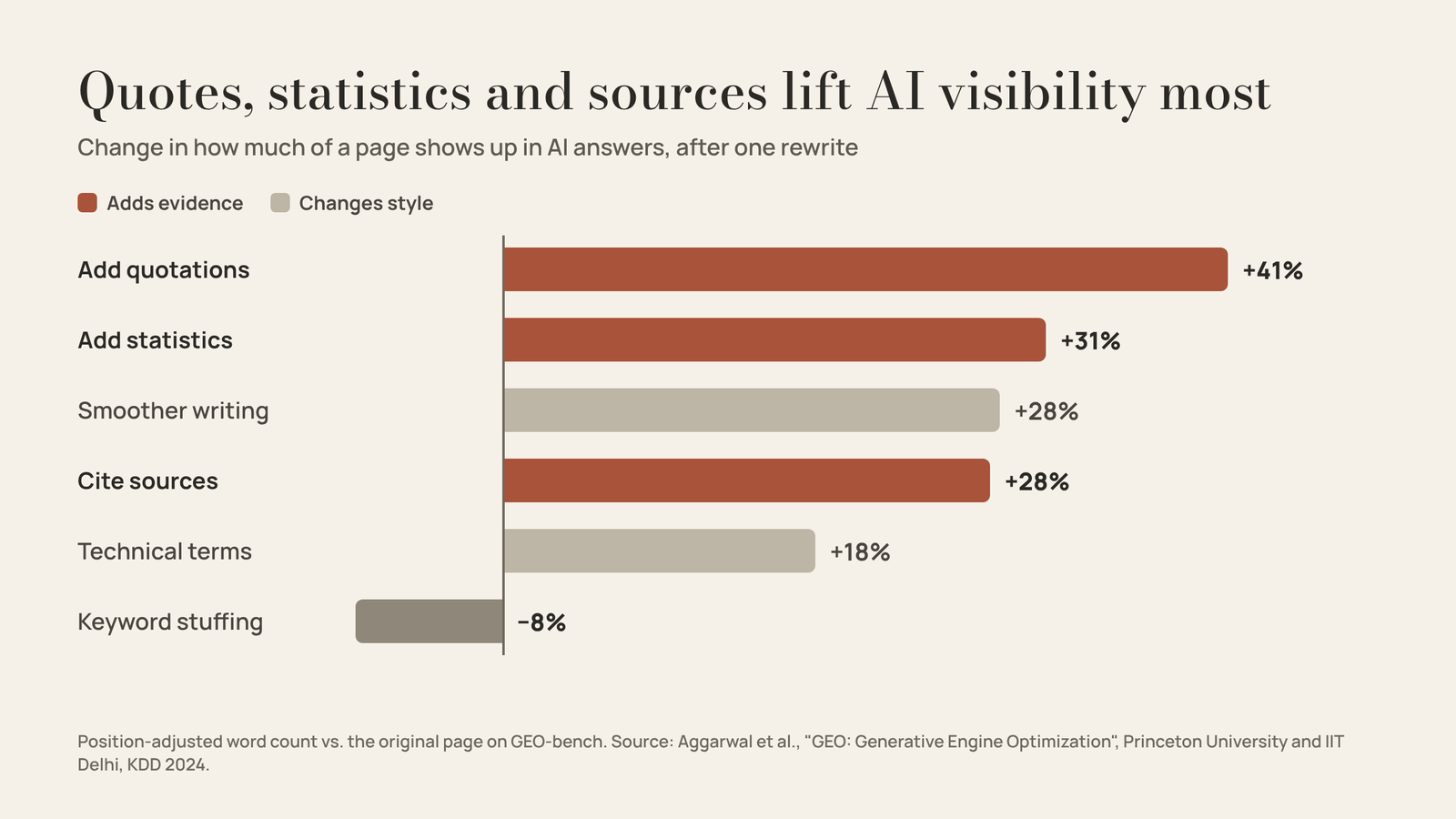
The result smaller brands should notice: pages ranked fifth in search gained much more than pages ranked first. Citing sources lifted a fifth-ranked page by about 115%, while the top-ranked page lost some visibility.11 The tests ran on a research benchmark built in 2023, not a live store, so read the numbers as direction rather than a forecast.
On a product page, that means facts an AI can lift and repeat:
- Beauty: “a fragrance-free moisturizer for dry, sensitive skin, 50 ml” tells a model more than “a luxurious hydration ritual.”
- Accessories: “full-grain calf leather, fits a 14-inch laptop, 1.1 kg” is easier to match to a question than “timeless elegance.”
- Luxury: name the materials, where it’s made, and the care and repair policy. Those are the details people ask an AI to compare.
- Fashion: give real garment measurements and a plain fit note, such as “runs small, size up.”
Put the answer in the first sentence of each section, add a short FAQ built from questions customers really ask, and cite where your numbers come from. The examples above are illustrations, so use your own verified details.
Get talked about off your own site
AI tools rarely rely on a brand’s own site alone. In a March 2026 analysis of about 30 million cited sources in the US, Peec found Reddit among the five most cited domains on ChatGPT, Google AI Overviews, AI Mode, Gemini and Perplexity, and YouTube in the top five on all of them except ChatGPT.12
In beauty, fashion and luxury that conversation already exists: review threads, try-on videos, dupe comparisons and editorial roundups. An AI reads it alongside your product page when it decides what to recommend.
- Ask customers to review you where your shoppers actually read reviews, not only on your own site.
- Work with creators who explain the product clearly, on camera and in their captions: what it’s made of, who it suits, what it costs.
- Keep your brand name, product names and one-line description identical everywhere, so every mention is clearly about the same brand.
Technical basics
- Check robots.txt. Allow the crawlers that power search and answers: OAI-SearchBot, Claude-SearchBot, Claude-User, PerplexityBot and Googlebot. Training crawlers such as GPTBot and ClaudeBot are a separate decision. Google-Extended is the exception, because blocking it also keeps you out of the Gemini app’s answers.6
- Make key product details visible in the page’s HTML, not only after scripts run. Adobe found that about 34% of the retail product pages it tested could not be properly accessed by AI.1
- Add structured data for products, prices, reviews and FAQs, and keep it identical to what the page shows.2
- Keep your product feed current. ChatGPT ranks merchants on factors like availability, price and quality, so a wrong price or a stale “in stock” works against you.4
How to measure it
GEO is harder to track than SEO, but you can start with tools you already have.
- Referral traffic. In your analytics, filter visits from chatgpt.com (they carry utm_source=chatgpt.com), perplexity.ai, gemini.google.com and claude.ai, and follow them month by month.3
- Search Console. Visits from AI Overviews and AI Mode are folded into your normal Web search numbers, so you will see them but can’t separate them.2
- A monthly prompt check. Write down the 20 questions your customers ask before they buy. Each month, ask them on all six platforms and log whether your brand appears, in what position, and which sources the answer cites.
The sources column is often the most useful. If the same Reddit thread or magazine roundup keeps showing up, that is where your next review or partnership should go. Count only questions people ask before a purchase, since being named in an unrelated answer won’t sell anything.
A 90-day plan
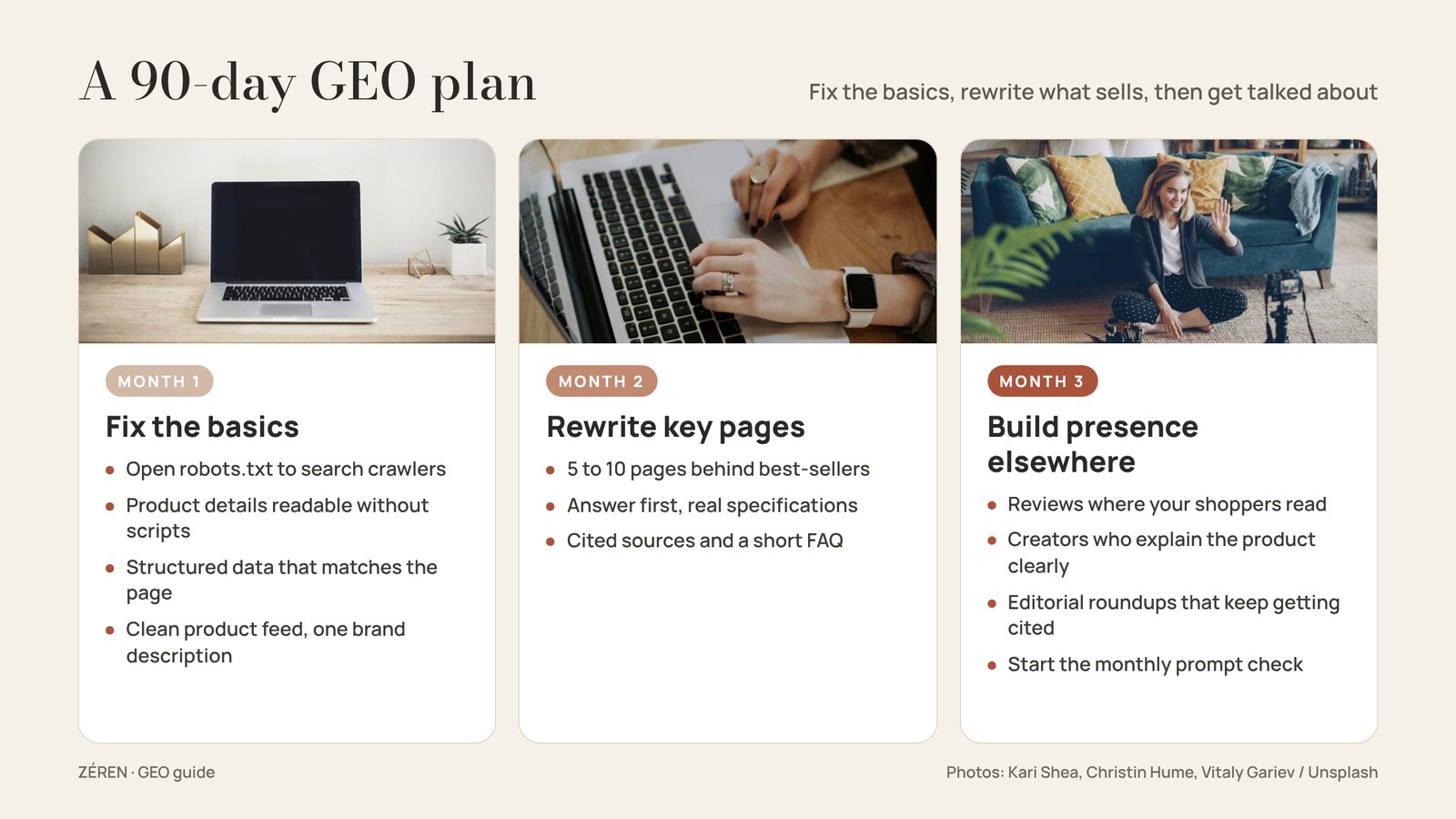
- Month 1, fix the basics. Open robots.txt to the search crawlers, make product details readable without scripts, add matching structured data, clean up the product feed, and use one consistent description of your brand everywhere.
- Month 2, rewrite your key pages. Pick the 5 to 10 pages behind your best-selling products and rewrite them around real customer questions: the answer first, real specifications, cited sources and a short FAQ.
- Month 3, build presence elsewhere. Grow reviews on the platforms your shoppers read, brief creators to explain the product clearly, pitch the editorial roundups that keep getting cited, and start the monthly prompt check.
You can start this week with one test. Ask ChatGPT, Gemini and Perplexity the question your best customer asks before buying, and write down which brands come up and which sources the answers cite. That list tells you where to begin.